Saturday, February 12, 2011

Pruning a Fruit Tree 101

Warm, sunny winter days are perfect for pruning fruit trees. The lack of snow and ice reduces the danger inherent in walking around, climbing, and cutting a tree with a pruning saw in your hand. Additionally, the lack of leaves and fruit on the trees helps you to easily identify which limbs to cut. It also is healthier for the tree because the sap is not flowing yet which allows the cut to heal better.

The first place to start is to cut every tiny sucker coming of the trunk and main branches. These suckers do nothing but sap energy from the tree. The photograph below is an examples of a sucker.


Once all of the suckers are cut, the next step is to cut all limbs that are growing perpendicularly straight up from a main branch. In other words, if a limb is growing straight up from a main branch rather than diagonally upward and outward, it should be cut. Depending on how long it has been since the tree was last pruned, these limbs can be small, medium, or large. Some are so large that they have many more limbs growing off them. Regardless of their size, they should be cut. The photos below show examples of small, medium and large limbs that are growing perpendicularly straight up from a main branch and that should be cut.


A small limb growing perpendicularly straight up from a main branch.


A medium limb growing perpendicularly straight up from a main branch.


An example of large limbs growing perpendicularly straight up from a main branch.


In this photo, Ken is cutting large limbs growing perpendicularly straight up from a main branch. This photo was taken about half way through this tree's pruning.


The final and longest step in pruning a tree is to cut out the limbs that criss-cross each other or that are tangled up (see close up example of criss crossing above). This tangling is undesirable because it does not allow enough air and sunlight to circulate in and around the tree, especially once the leaves and fruit start to develop later in the spring. Additionally, when there is an excessive number of limbs on a tree, the energy created from the photosynthesis process is used to support the numerous branches rather than the fruit. This results in smaller fruit at harvest time. In the photo above, the limbs growing diagonally upward will be cut out.


The above photo is an example of many limbs criss crossing and tangling. Approximately half of these limbs, especially the ones growing diagonally upward, will be cut out. This part of the pruning process is more art than science because it requires a good eye. Sometimes it can be done by cutting only a small limb. Other times it requires larger cuts or even the removal of an entire branch.


Ken is almost done pruning this last tree. As you can see, this lower branch has limbs growing both perpendicularly upward and criss crossing with the limbs growing from the above branches. Although it is clear that more pruning is necessary on this tree, it is also important not to remove more than 30% of the tree at one time because it will shock the tree, so this tree is done for this year. Next year, Ken will cut and remove the majority of the limbs on this lower branch, and then the pruning job will be complete.

Friday, February 11, 2011

For the Love of Brutus

As many of you know, we are obsessed with English bulldogs. The latest addition to our brood is Brutus. He is a 5 year old, tan and white male who we adopted last summer. This is the story of how we came to be his forever home.

We never planned on getting a second English bulldog. As most owners of this breed know, one is usually more than an enough. However, the dominant bitchiness inherent in our 2-year old English bulldog, Hope, never subsided even after we had her spayed and she reached adulthood. She woke up every morning to make another valiant attempt at ruling the world. However, she has always gotten along well with other animals. After deep thought and discussion, we decided that it would be best if she was not an only child. . . er, bulldog.

We knew we did not want a puppy because potty training and "chew patrol" is a full-time job that we did not have time for. Instead, we decided to attempt to adopt an older English bulldog, so we spent an entire Sunday afternoon on www.petfinder.com and contacted every rescue organization within a day's drive that had an English bulldog that was dog friendly, cat friendly, and child friendly. That was a pretty short list to be sure. All Tails R Waggin' in Pataskala, OH (just outside of Columbus) was the first rescue organization that we contacted, and they were the first to respond to our inquiry. All Tails R Waggin' (www.alltails.com) is a boarding and grooming business that also does volunteer rescue work on the side. The rescue dogs stay in the extra kennels they have at their beautiful, clean facility.

We learned that Brutus had just been placed on the rescue website that day. He was a happy, healthy dog that was surrendered for financial reasons. Essentially, Brutus was yet another casualty of the economic collapse that occurred in late 2008. His previous family's primary breadwinner had lost his/her job, and the family could no longer afford Brutus. All Tails R Waggin' completed our background check for Brutus in less than 1 week. By Saturday, we loaded up Liam, Hope, and the dog crate in the Subaru Outback and headed off for the 5 hour journey to Pataskala with our fingers crossed that all would turn out okay. We eventually arrived at All Tails R Waggin' , picked up Brutus, placed him in the dog crate, and headed home right away.

After just a short time on the road, we were afraid Brutus was not going to make it home. Like many English Bulldogs, he overheats very easily. He was panting for dear life in the back of the car, so we placed him in the backseat with Liam in the car seat in the middle and Hope on the other side. It was quite a sight, but thankfully they all got along very well. However, Brutus was still panting, so we put him on the front floor board with all of the air conditioning vents on high and on him. He eventually cooled down, and we made it home safely.

Brutus fit in very well at The Ponderosa Lodge from the very beginning. He truly fits the bulldog stereotype in every way. He is beyond easy going, and he loves nothing more than a good bone, a nice toy, and a little bit of love. He would sleep in his crate all day if we would let him, but he has gotten used to climbing the mountains around here with us. He is also a first-rate snorer and farter. What more could an English bulldog lover ask for? He is such a good, good boy, and we feel very blessed to have been chosen to be his forever home.


Unfortunately, our veterinarian diagnosed Brutus with entropium shortly after we brought him home. This is a very common condition in English bulldogs. Essentially, the wrinkles near their eyes droop into they eyes which causes the fur on the skin to scratch the cornea. It requires an operation which is basically an eye-lift for dogs. His surgery went well, but poor Brutus's temperature spiked very high as the anesthesia was wearing off. Our veterinarian placed him in an ice bath and kept him over night for observation. Thankfully, we were allowed to bring him home the next day. It looks like he may require another entropium surgery in the future, but we are keeping our fingers crossed for the best. (The photos above and below are of Brutus's (AKA Frankendog's) eyes right after surgery with the stitches still in place).

Brutus gets along with all the guests at The Ponderosa Lodge. He is in our private area most of the time, but he especially likes to sneak down to the kitchen and hide in the cubby next to the trash can hoping that some guests will drop him some food while they are cooking.


Most importantly, Brutus has been very good for Hope. They are not exactly best friends, but they do get along well and his older, more subdued personality seems to keep her in her place. Hope still wakes up every morning with the goal to rule the world. She probably always will, but, thankfully, Hope finally seems to realize that that world does not revolve completely around her.

Sunday, February 6, 2011

Fresh Vegetables Available in Northern Hemisphere by Month

Many people have heard the advice to eat seasonally and/or locally. However, most of us are so far removed from our food source, that we have no idea what this really means. Below is a list organized by month that details the fresh vegetables that are available during each month of the year. Please note that this list may vary according to which specific agricultural zone you live in, but it's a good start for most individuals who live in the Northern Hemisphere. Additionally, please note that some vegetables, such as potatoes, onions, and winter squash, store well and can be available all winter long.

Jan - Mar

Kale


April

Asparagus

Swiss chard


May

Asparagus

Sugar peas

Lettuce (leaf)

Spinach

Wild greens

Comfrey

Turnip greens


June

Asparagus

Beans

Peppers

Lettuce

Peas

Zucchini

New Zealand spinach

Onions

Broccoli

Kohlrabi

Cabbage

July

Asparagus

Beans

Peppers

Lettuce

Peas

Zucchini

New Zealand spinach

Onions

Broccoli

Kohlrabi

Cabbage

Corn

Tomatoes

Cucumbers

Carrots

Beets

August

Beans

Peppers

Lettuce

Zucchini

New Zealand spinach

Onions

Broccoli

Kohlrabi

Cabbage

Corn

Tomatoes

Cucumbers

Carrots

Beets

September

Corn

Tomatoes

Peppers

Lettuce

Eggplant

Broccoli

Cabbage

Spinach

Zucchini

Cucumbers

Potatoes

Escarole

Chinese cabbage

Carrots

Beets


October

Tomatoes

Peppers

Lettuce

Eggplant

Broccoli

Cabbage

Spinach

Zucchini

Cucumbers

Potatoes

Escarole

Chinese cabbage

Carrots

Beets

Winter squash

Parsnips

Salsify

Brussels sprouts

Kale

Collards

Turnips

Leeks

Rutabagas

Winter radishes

Sweet potatoes

Cauliflower

Beans


November

Parsnips

Salsify

Brussels sprouts

Kale

Collards

Turnips

Leeks

Head lettuce

Spinach

Rutabagas

Winter radishes

Rutabagas

Broccoli

Cauliflower

Escarole

Chinese cabbage

Regular cabbage

Carrots


December

Leeks

Kale

Chinese cabbage

Parsnips

Carrots

Salsify

Brussels sprouts

Saturday, February 5, 2011

Carving a Bowl, Part 1

Winters in the high mountains of West Virginia are long, cold, dark, isolating, snowy, and really hard work. We spend much of our time splitting and stacking wood, tending to the fire, and keeping the sidewalk and driveway clear of snow. I always chuckle when our guests at The Ponderosa Lodge mention our "simple" life here because it is any thing but simple. Basic, yes; simple, not exactly. So, when the weather breaks and the temperature is unusually warm (ie. slightly above freezing) for a week, it is nice to get out and do something. My husband bought me a set of wood carving tools for Christmas (pictured below), so I decided to head down to our friend Dennis's wood workshop to learn how to carve a wood bowl.


Dennis is a native of West Virginia, and he has been carving for more than 50 years. If you have ever visited The Ponderosa Lodge, you will recognize his beautiful work because he carved the coffee table, sofa table, and end tables in the Great Room. He also carved all of our bread bowls, and we sell these items and many more at the lodge. Below is a photo of a big beautiful bowl carved from a tree knot that he is working on for us.


Unfortunately, when I arrived at Dennis's workshop (pictured below), he was not feeling well because he had a chemotherapy treatment yesterday, so I spent the day carving with his brother, Mac, and his wife, Dee.


This is the inside of Dennis's wood workshop and some of his cool power tools.


This is the piece of wood that I started with. It is a piece of cherry log split down the middle. I plan to carve it into a small bowl.


Mac first used a drill press to remove a little bit of the wood from the top. This makes the overall process a little bit quicker, and it also makes it easier for me to carve out the inside of the bowl with my carving tools.

Liam and Ken also brought their own "tools," and they joined in the fun.


Liam was very interested in assisting me while I carved. The whole process is fairly simple. Essentially, you hold the gouge (pictured in my left hand) by the wood handle and place the sharp metal end against the wood where you want to carve. Then you hammer the handle of the gouge with a soft headed mallet (pictured in my right hand). The force of the mallet causes the sharp end of the gouge to carve out little pieces of wood. This process allows you to slowly carve out the inside of the bowl. Apparently, the idea is to carve the bowl as thin as possible without actually carving a hole in the bowl. (Although Mac promised me he could patch the bowl if I accidentally do carve a hole in the bowl). Thankfully, I did not chop off any fingers, but I did slice a hole right through my work jeans with the super sharp gouge.


This is my little bowl after about 2 hours of carving.


This is my bowl after about 3 hours of carving. I still need to carve about 1/2" more to create the bottom of the bowl and then carve out the sides as well. Then, I will sand the inside and outside of the bowl. I plan to keep most of the bark on the outside, but Mac will sand around the corners so they are rounded rather than square.


Dee sanded these bowls while I carved mine. Sanding is one of the final steps in the process. She is nearly done with these bowls.

Friday, February 4, 2011

Cold Storage

I was very excited when Ken and Mac completed our cold storage room in 2010. They tore down 2 block walls and ripped out an unused shower stall, sink, and toilet to open up a space that would be big enough to hold 2 deep freezers and make shift shelves to hold winter squash, pumpkins, onion, apples, potatoes, and other produce that stores well. In Spring, Fall, and Winter, this room generally stays around 40 degrees which is the perfect temperature for the long term storage of crops. This low temperature also decreases the amount of electricity that the freezers use which is greener for the environment and keeps our electric bills lower. The cold storage room is located between the garage and the lodge, so every time I walk by it, I have the opportunity to admire the non-GMO, non-hybrid heirloom veggies we raised in our vegetable gardens this year.


My favorite crop that we grew for long term storage is the jarrahdale pumpkin. It is a slate, blue-grey pumpkin that weighs 6-10 pounds. Its shape is flat, ribbed, and very decorative. It is a good keeper. As a practical matter, it was very easy to grow, but the vines do require a large amount of garden space. Also, it is very easy to clean out and cook up because the flesh is smooth rather than stringy, and it has a very delicious flesh. These pumpkins are not available at traditional groceries, but they are sometimes available at farmer's markets in Fall.


I admired our jarrahdale pumpkins sitting in our cold storage for the past 4 months instead of eating them, so they were starting to spoil a little. The majority of the inside flesh was fine, but it was definitely time to do something with them.


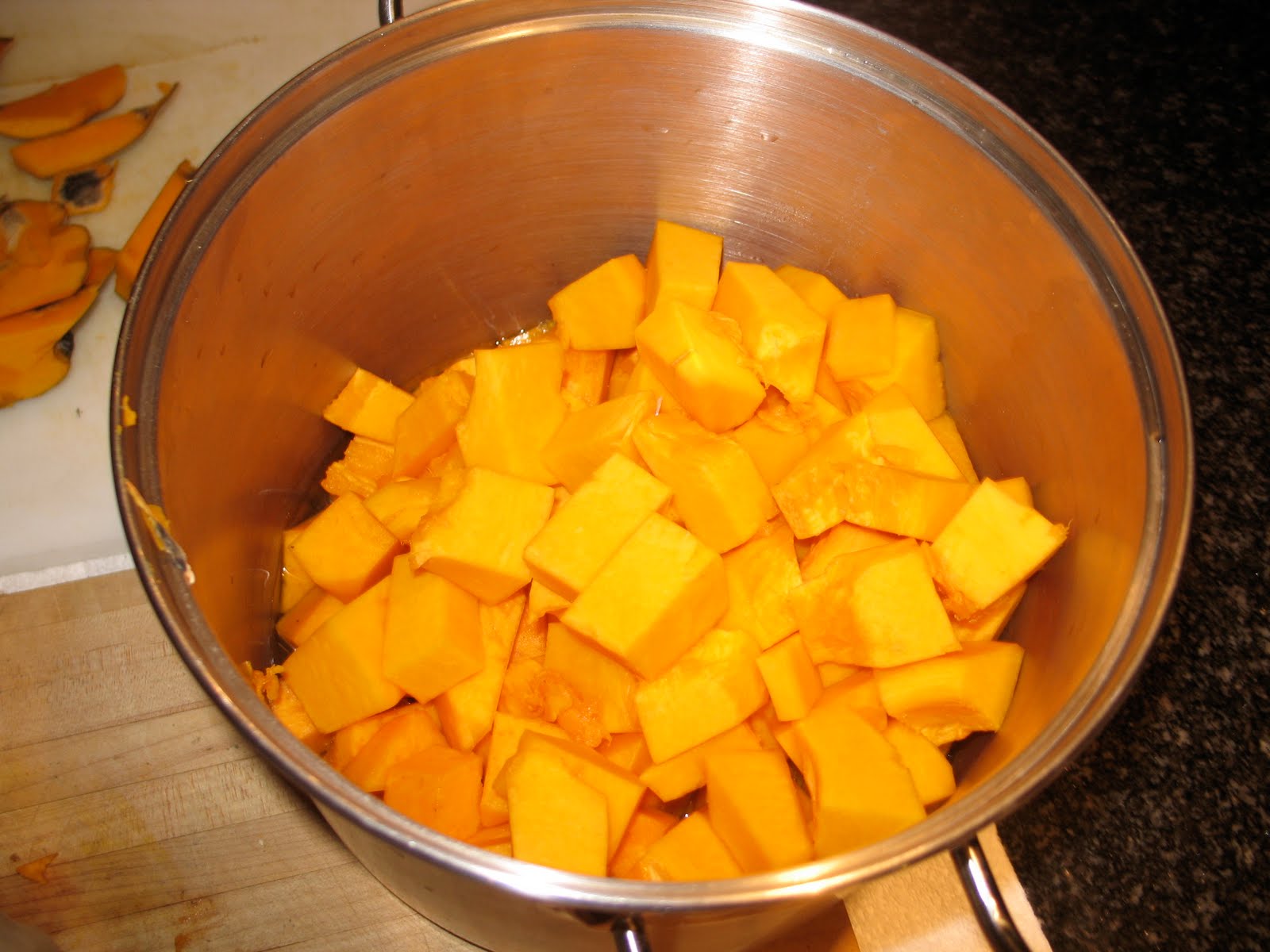
Ken cut open, seeded, and cubed the pumpkin.


Then, he placed the cubed pumpkin in a large stock pot and cooked it down. We will use the resulting pumpkin puree to make pumpkin soup tomorrow. The rest of the pumpkin puree will be placed in Ziploc bags and put in the freezer. We will use the puree this summer to make pumpkin bread for our guests at The Ponderosa Lodge.


Thursday, February 3, 2011

Preparing and Planning

The past couple of days, we had some above freezing temperatures that got be pining for digging and planting in the garden. Winter has returned, though, but there is much to do to prepare for Spring.

I took advantage of the nice day yesterday and cleaned our wood stove and chimney. We burn a lot of wood in our stove and I have to sweep it 4 or 5 times throughout the season. We use the stove to heat our dining room and kitchen as well as keeping the dogs warm.

I also will begin inspecting and disinfection my maple sap collection equipment. I wash the buckets, spiles, lids, and milk jugs in a solution of 1 part unscented bleach to 20 parts water. We have over a dozen sugar maple trees on our farm that I tap each season. I hope to start tapping trees in another week or two.


I also clean my seed starting pots in a solution of the same mixture. In the next couple of days I will begin starting seeds indoors, with the first ones being onions, asparagus, rhubarb, lettuce, and spinach. Once these plants germinate they will be moved outdoors to the cold frames. I also will draw plans for my gardens this year and decide what varieties to grow.


Last, I need to clean a room and prepare for our first intern of the 2011 season! Erich will be joining us next week. He is one of many interns who will be joining us this season and we are exciting to be working with everyone of them.

With Erich, we plan to make some repairs and do some painting indoors until the weather breaks. Then we have a lot of work to do outside. Some of the projects we have planned are building more raised beds, preparing the gardens, building new rabbit pens, converting the chicken coop into a garden shed for Jorene, and trimming apple trees. Look for more posts on our progress throughout the season.

Friday, January 21, 2011

Intern Positions Available

OUR INTERSHIP POSITIONS FOR SPRING AND SUMMER 2011 ARE CURRENTLY FILLED. IF YOU ARE INTERESTED IN INTERNING FALL 2011, PLEASE FEEL FREE TO CONTACT US. HAPPY GROWING!! We are seeking an intern(s) to join us for Fall 2011. Our interns will be provided room and board, all meals, free internet and U.S. domestic telephone calls, and the use of a vehicle. We would also be happy to fill out any paperwork that would allow you to get college credit for your work. We are unique in that we specialize in both small organic farming and lodging. All interns should be willing to participate in both sides of the business. Please feel free to contact us for further information. We are located in the New River Gorge area of southern West Virginia which is noted for countless exciting outdoor activities, including whitewater rafting, rock climbing, fishing, horseback riding, tree canopy tours, boating, and hiking. For more information about our farm located in Southern Western Virginia, please visit our Facebook page (The Ponderosa Lodge), or our website at: www.theponderosalodge.com