Showing posts with label pasturing. Show all posts

Tuesday, June 29, 2010

Chicks - Week 8

It's hard to believe it's almost July. This batch of poultry has been out to pasture for four weeks now. I prepared the brooder house for our next round of turkeys, which we will raise for Thanksgiving. At this point in time, I would be planning to butcher Cornish Rocs. The Freedom Ranger Broilers have gained considerable weight, and some could be ready to butcher in a week or so. I plan to butcher all of them by the middle of July, when they are 11 weeks old. They love to forage, much more than Cornish Rocs do, and have eaten a great deal of grass. I'm also impressed with the foraging capabilities of the ducks. Along with the turkeys and the broilers, they are all keeping me busy with moving their fence. I move them to fresh pasture ever other day, now.


Liam loves feeding them every day. He's almost as tall as the 42" fence.

Thursday, June 17, 2010

Chicks - Week 6

The chicks sure are growing. They love being in the fields now and spend most of their time grazing. I bought a kiddie pool for the ducks today. They say that you don't need a pond when raising ducks, but I thought they would enjoy playing in the pool. They took to it like ducks to water. Even the turkeys got in the pool. Enjoy the pictures.


Thursday, June 3, 2010

Chicks - Week 3

I apologize for writing this update late, but we were swamped this past week with guests at the lodge. So, the chicks are a little more than 3 weeks old now, and it was time to move them to their field pen. There, they can get exercise, sunshine and eat fresh grass and bugs. This saves on my feed bill by as much as 40% and produces a healthier bird.

Here they are in their field pen. The pen is 4' x 8', enough space for them to roam around inside without being too crowded. I'll keep them confined for a couple of days to get settled. Then, I will allow them to free range behind an electrified poultry net. I would also like to provide a small water pond for the duck to use for bathing. For now, I move their pen twice a day to give them fresh grass to eat and to lay on.


Saturday, May 22, 2010

Chicks - Week 2


It's the end of weeks 2 for our new chicks, and they sure have grown. I'm especially amazed at how fast the Peking duck grows. I can make out the different colors for the Freedom Ranger Broilers now. They are tricolor, redbro and yellow. I expanded the brooder floor space to give them more to move around. They are getting hardier now, so I keep the heat on at night, but turn it off during the day. Next week I will start letting them outside during the day to forage.

Tuesday, May 11, 2010

Goat Pictures

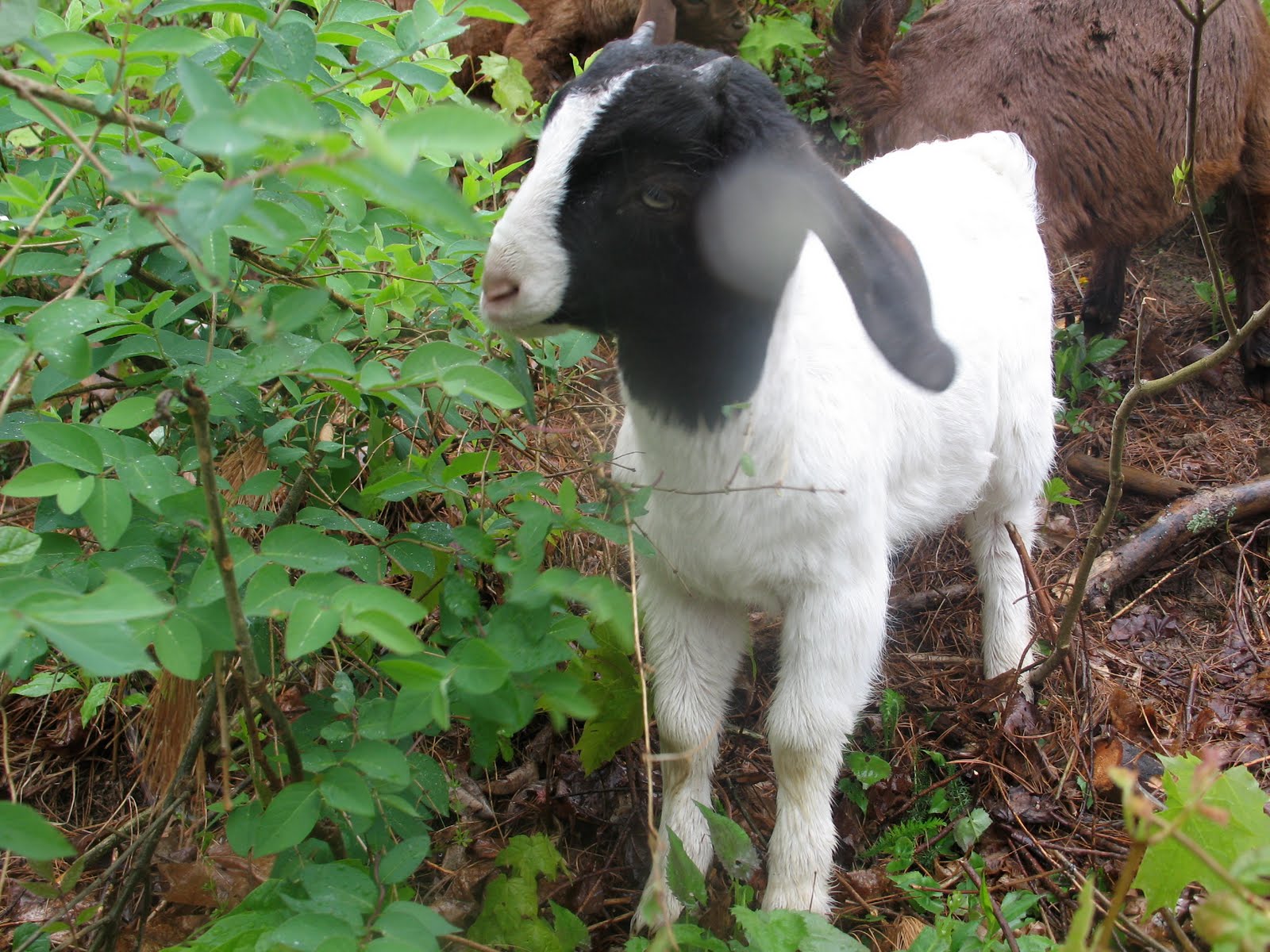
This morning, I let the boer goats free to graze on the hillside. I had to lead them out of the barn. Then, when I walked back in, they followed me back inside. So I led them back out and stood on the hill with them for awhile. They took to eating the brush immediately and seem quite happy. As promised, here are some more pictures of them.


Sunday, May 9, 2010

Another Addittion to the Farm

Sunday, we picked up a Red Angus steer to add to our farm. He is a yearling and weighs 615 lbs. I hope he will be around 800 - 900 lbs. by this fall. Like all of the animals on our farm, he will be raised on clean, organic pasture. Other than worming medicine, he will not receive antibiotics, vaccines or synthetic growth supplements.

Saturday, May 8, 2010

Boer Goats


Saturday, we drove to Wyoming county, WV to pick up 6 boer goats for our farm. The farm where we were getting them was over 2 hours away, so we started out early in the morning.

The boer goats will be my "brush clearing" crew in the 8 acres we just finished fencing. We picked up 3 nannies and 3 billies. I was surprised at how small they were. We plan to keep them in the barn for a couple of days, until they get adjusted to their new home. When I put them out to pasture I'll take more pictures. Link
One of the billies needs bottle fed twice a day for the next three weeks.

Liam loves his animals.

Friday, May 7, 2010

New Chicks!

Today, we picked up our chicks at the post office and at Southern States. We ordered 50 Freedom Ranger Broilers, from J. M. Hatchery. They are meat bird from the Label Rouge program. It is highly adapted for pasture, free range raising. It is a slower growing bird than the Cornish Cross and is supposed to produce a firmer, tastier meat. This is our first year of growing them, so we'll let you know what we think.

Liam was excited about getting our Freedom Rangers at the post office.

We also picked up a Pekin duck and 4 Broad Breasted White turkeys at Southern States. We have been going to chick day there for 3 years now. It is a tradition with our family and Liam really enjoys seeing all of the chicks.

Jorene and Liam in front of the store.

Liam really likes seeing all of the chicks.

What's this Daddy?

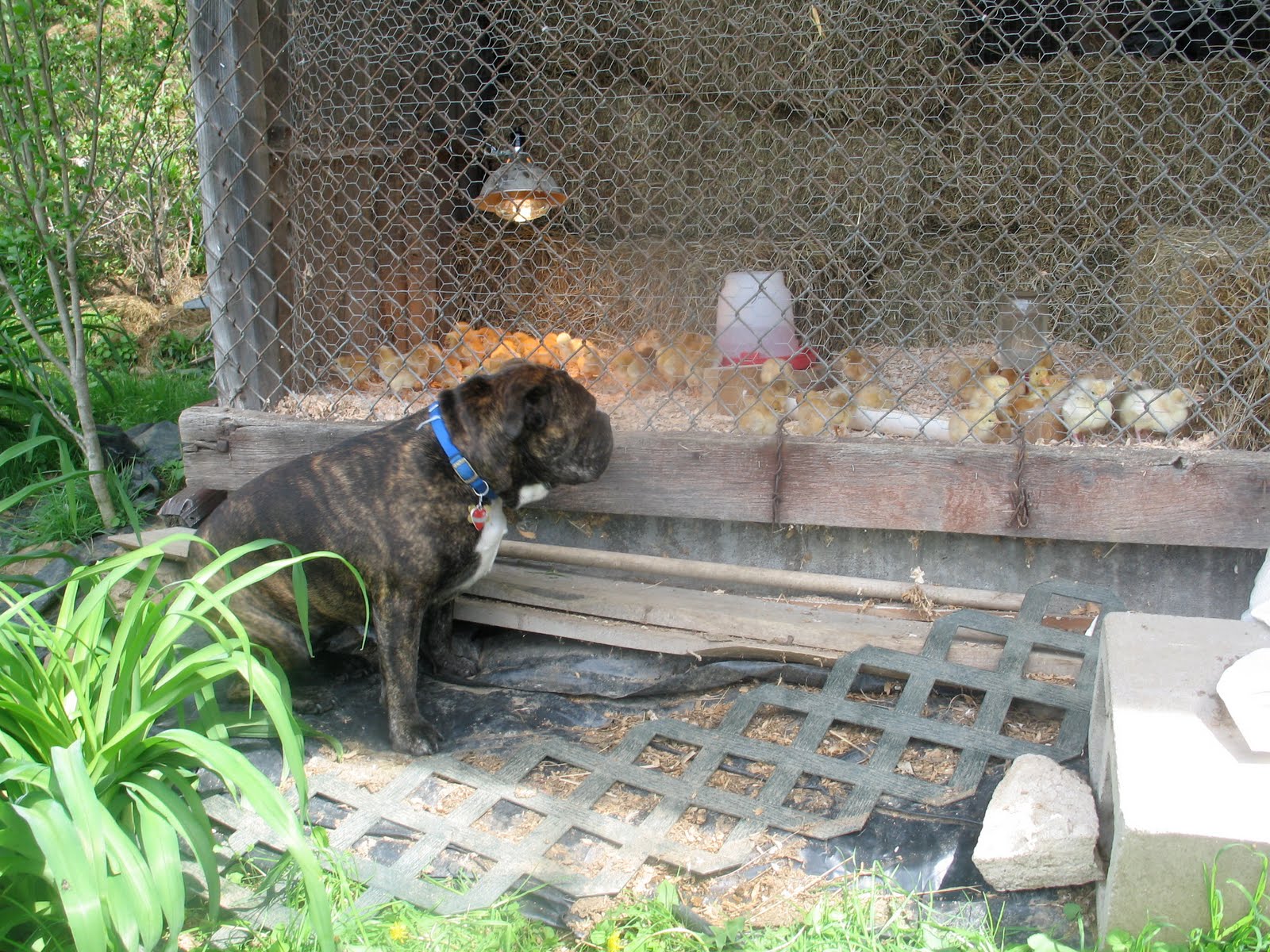
Hope, on guard at the brooder house.

Saturday, January 30, 2010

An Alternative to the Cornish Cross

For years, we have raised chickens here on the farm, both for meat and eggs. The standard breed to raise for meat is the Cornish Cross. It is the same bird that the major producers raise and has been bred for quick development and large breast size. Wanting the best quality meat that we can produce, we raised our birds on pasture and supplemented their feed with locally milled grain, free of animal by-products and chemicals. Last year, I built several pens following the model of Joel Salatin at Polyface Farms, and moved this every day so they would have fresh pasture.

Over the years, though, the Cornish Cross has been hybridized and genetically manipulated by the poultry industry to suit their confined farming style. The Cornish Cross has been bred to put on weight at an astronomical rate, reaching 5 pounds of live weight by 42 days of age. The aim was to produce a bird that basically sits, eats, and grows quickly while producing a lot of breast meat. However, this incredible fast growth is detrimental to the birds welfare and health. Since they have been selected for high muscle-to-bone ratio, the Cornish Cross bird often suffers from joint, ligament, and muscle problems as well as hock burn and other skin ailments. Their heavy weight makes them prone to heart strain and sudden heart failure. Their immune systems have been compromised through selective breeding, and they are susceptible to many infectious diseases. Due to these health concerns, the common practice is to keep the birds on antibiotics their entire, short life. Because of all of these problems, the Animal Welfare Approved association has determined that the Cornish Cross breed "is inherently flawed as a high-welfare pasture-raised bird," and they are encouraging small farmers like us to experiment with other breeds that do not have the problems that the Cornish Cross have.


This year, I am going to switch to an alternative breed of bird to raise for meat. Freedom Ranger Chickens are derived from the American and European old heritage breed of chicken and was developed in the early 1960’s to meet the highest standards of the French Label Rouge Free Range program. Currently, the Freedom Ranger genetic stock is used by most non-factory farm production models (alternative) all across Europe and also by small pastured poultry producers in search of a traditionally raised farm chicken. They are naturally better suited to the higher welfare and all true natural rearing systems (full pasturing, free range, organic, certified, backyard etc.…). They reach 5 to 6 pounds live weight in 9 to 11 weeks. Because they are allowed to grow longer, their meat is more tender and firm. They are also bred for flavor rather than rapid muscle-to-bone ratio. Therefore, they are highly sought after by chefs. As always, our chickens will be pasture-raised, giving them the benefits of exercise and sunshine. I plan to house them in a movable coop with temporary fencing, giving them more space for free range pasturing. We will also continue to feed them with locally milled grains free of antibiotics and animal by-products.

We put several dozen chickens in our freezer from last summer, and are still eating them. I like to roast a bird once a week. We get several meals from the meat, and I put the bones in a pot of water with scrap vegetables to make fresh, natural chicken stock. I generally can get 3 - 4 quarts of chicken stock from 1 chicken.

Saturday, December 5, 2009

Farm Roundup

It's been a long time since I've written. My goal next year is to post once a week. If I get into a habit with it, I'm sure I can keep it up. But it is time now for a farm review of the animals we raised this year.


The turkeys were a new addition to our farm this year. I raised 3 Broad Breasted White Turkeys, 2 toms and 1 hen. They were an absolute joy to raise.

I started them in a brooder house with broiler chickens. They looked much like the broilers, except for a longer neck. But, at 3 weeks, I could pick out the toms. They were strutting around, wings stretched out and trying to look big. It was hilarious. I moved them to the field at 8 weeks, later than the chickens because they were growing slower. Once they were in the fields, though, they showed their value as pastured animals. They will eat about 60% of their diet from the pasture (grass and bugs), which cut their feed bill down quite a bit. I supplemented their diet with a locally milled poultry finisher feed. In fact, all of our feed is locally milled and doesn't contain animal by-products, antibiotics or growth hormones.

I kept the turkeys in a movable pen and poultry fencing. The pen was very heavy and hard to move without assistance, so it needs some modifications before next season. The fencing was step-in posts with 4' high poultry netting. This worked fine for the turkeys until 18 weeks, or so. At that point, they were all at least 25 lbs. and just pushed the fence over. What was great, was that they would follow me back to their pen whenever they got out. Next year I will use electrified poultry netting to keep them safe from wandering and from predators.

I butchered them in time for Thanksgiving, at 24 weeks. The toms dressed out at 37 and 40 lbs. and the hen at 25 lbs! And they were delicious. We were very pleased with them.

I will definitely raise turkeys again next year. I'd like to try butchering them at different times to get some smaller sizes. I'd also like to make ground turkey for turkey sausage. They are far superior to raising broiler chickens because of their higher consumption of pasture, less prone to predator attacks and friendliness. They are one of my favorites.


I also started raising rabbits this year. I purchased 2 does and 1 buck from Polyface Farms in May, as well as a mixed breed doe from a local farmer. We raised several litters, putting them out to pasture in field pens at 6 weeks. The rabbits are another favorite of mine. Their field pens are tremendously easy to build and move and they are a joy to watch in the fields. Guests at our lodge loved watching the rabbits and feeding them grass. At 12 weeks, they typically dress out at 4 lbs., which is a great meal for our family. Liam, our 1 year old, loves roasted rabbit and will eat all that we put on his plate. If you would like to try rabbit, here is our favorite recipe.

We had to cull one doe from our breeding stock. I bred her twice but she didn't produce a litter. I also lost a litter because I didn't put the nest box in for the doe early enough. She gave birth that night and left the babies outside the box. When I found them the next morning they were cold and lost. I know now to put the box in a week before the planned due date.

Other than those setbacks, we have been very pleased with raising rabbits on pasture. They are easy to raise, consume a lot of grass and garden scraps which cuts back on their feed bill, provide us with clean manure for the gardens, and are a good meal. By comparison, they are far superior to chickens for meat.


Once again, we raised hogs. This year, I had some friends who were interested in whole or half hogs, so we raised 5 hogs. I bought them from a local farmer at 225 lbs. and finished them to over 300 lbs. I kept them corralled in a pen next to our barn, but would like to one day pasture them in our woods and fields. We have about 8 acres of land behind our lodge filled with hickory, beech, and oak trees. I hope next year to finish the hogs there, using electric fence to keep them contained.

This year, I learned how to butcher a hog, thus cutting down on our costs. This wasn't as hard as I thought it might be. I believe I got a better product than when I took them to a butcher last year. I kept 2 hogs for us, from which I made 60 lbs. of sausage, 30 lbs. of bacon, dry-cured hams, wet-cured hams and lots of roasts, tenderloin, chops and ribs.


I raised broiler chickens again this year and put them in field pens similar to the design at Polyface Farms. I had a major predator problem with raccoons, though. The raccoons pulled chickens through the 1 inch mesh wire and dug under the bottom rungs to grab legs and wings. I finally moved the remaining chickens into a shed and started setting traps for the raccoons. This summer I killed over 2 dozen raccoons and I don't think that is all of them. We are surrounded by hundreds of acres of woods, so I'm sure they will be around all of the time. My only solution is to surround the field pens with electric fence.

The chickens, though, are my least favorite to raise. They're smelly, even in the field pens, their stupid, and prone to predator attacks (much more so than the other animals). By comparison, rabbits and turkeys are much more enjoyable. Roast rabbit is just the same as chicken and I can make stock from the turkeys. The only reason I would see to raising chickens next year would be for fried chicken. So we'll see if I raise them again.

Tuesday, April 7, 2009

A Review and Beginning

When my wife and I moved to West Virginia 5 years ago to open a Bed & Breakfast, we envisioned one day growing and raising most of our own food for our guests and our family. We've tried many approaches to this goal, and had many successes, and setbacks, along the way. But we have learned a lot about farming in a mountainous environment. We own 16 acres along with our lodge, about 3/4 is wooded and every bit of it is rocky. I've made many compost piles and hauled a lot of manure from neighboring farms and, eventually, from our animals. We relied on the advice of old time farmers and friends, websites, blogs and books. Along the way, we wanted to start a blog, a farming journal, but didn't get to it right away. Now that I'm starting it, I thought a good beginning would be to review what we have tried and what we are starting this year with.


One of the first gardens beds we started was our raised beds for strawberries. These are June bearers and were started in the Fall of '07. Last year they gave us a wonderful crop of the most delicious berries. I plan to expand our strawberry beds and include both everbearers and June bearers.

We also planted sunflowers along the wall, and carrots (Danver Half Longs) in the clay pots

We have started an orchard with 6 apple trees (Wolfriver, Golden Delicious, Yellow Transparent and Red Rome), 3 pear trees (Honeysweet, Moonglow and Delicious), 2 cherry trees (Montmorency and Surecrop Pie), 2 nectarine trees (Royal Giant and Crimson Snow), and 3 peach trees (Redhaven and Delicious). We have 12 Heritage raspberry bushes, 6 thornless blackberries, 12 concord grapes, 6 seedless grapes (various varieties), 20 blueberry bushes (I like blueberries!), rhubarb and asparagus. All of these have been started in the last 2 years and are growing very well. Our biggest concern here is deer damage. I have to cover everything with wire and netting to keep the deer away. Every year I have tried to dwindle the deer population during hunting season, and every year there are more deer than before. The other day, Jorene and I saw 20 deer in the woods behind our house. This year is going to be challenging. I'll keep you posted with our progress.


Last year we also started raising animals. We started with chickens for meat and eggs and hogs. We raised 60 cornish rocs for 7 weeks. When we butchered them I had lost 5, so we were down to 55. We enlisted the aid of some friends to butcher them one day. All 55 chickens were cleaned and packaged for the freezer that day. By the end of the day I didn't mind that we had lost 5 chickens. It was a very long day and I don't think we will butcher that many in one day again. Thankfully our friends are still talking to us after that long day.

We also started 31 hens and 3 roosters. We only wanted 1 rooster, but they are so hard to tell when they are a day old. Today we have 28 hens and the 3 roosters. 3 hens were lost to the extremely cold winter here. This spring we will cull the hens and take out any that aren't laying. As for the roosters, there is 1 Black Australorp rooster whose days are numbered. He is a mean one and has tried to spur me several times. The other 2 (a Silver Laced Wyandot and a Barred Rock) we will keep to try to fertilize some of the hens. Our hens are a mixture of Barred Rocks, Silver Laced Wyandots, Ameraucanas, Black Australorps and Golden Comets.


My greatest joy, and frustration, was in raising 3 pigs. In February, we bought three 8 week old piglets to raise to butcher weight. After several months of very little weight gain and sky rocketing feed prices, we learned that we should give them deworming medicine once a month. We also added a self -feeder for the corn and pig nuggets. I don't know if this is all necessary, I just know that once we made these changes, they gained weight. In addition to the feed, the pigs were given garden and table scraps (vegetables, fruit and leftover breads). I guess what frustrated us the most was the feed prices, which doubled in July from the March prices. In the future I plan to get the pigs later in the year, so we will have more garden and orchard scraps available for free. I also would like to fence in some of our fields for hogs. One field in particular has hickory nut trees, which I gathered the nuts last year for them.

My first year of raising animals has moved me closer to the idea of pasturing our animals. This year we plan to utilize mobile pens for the chickens and rabbits (chicken and rabbit tractors). We also are planning to get turkeys from a friend who is incubating eggs, which we will pasture with mobile fencing. Pasturing offers the animals a greater variety of nutrients in their diet as well as fresh air, sunshine, bugs and exercise while they provide fertilizer to the grasses.